AI Transformation Is Forcing Organisations to Redesign Work
Insight
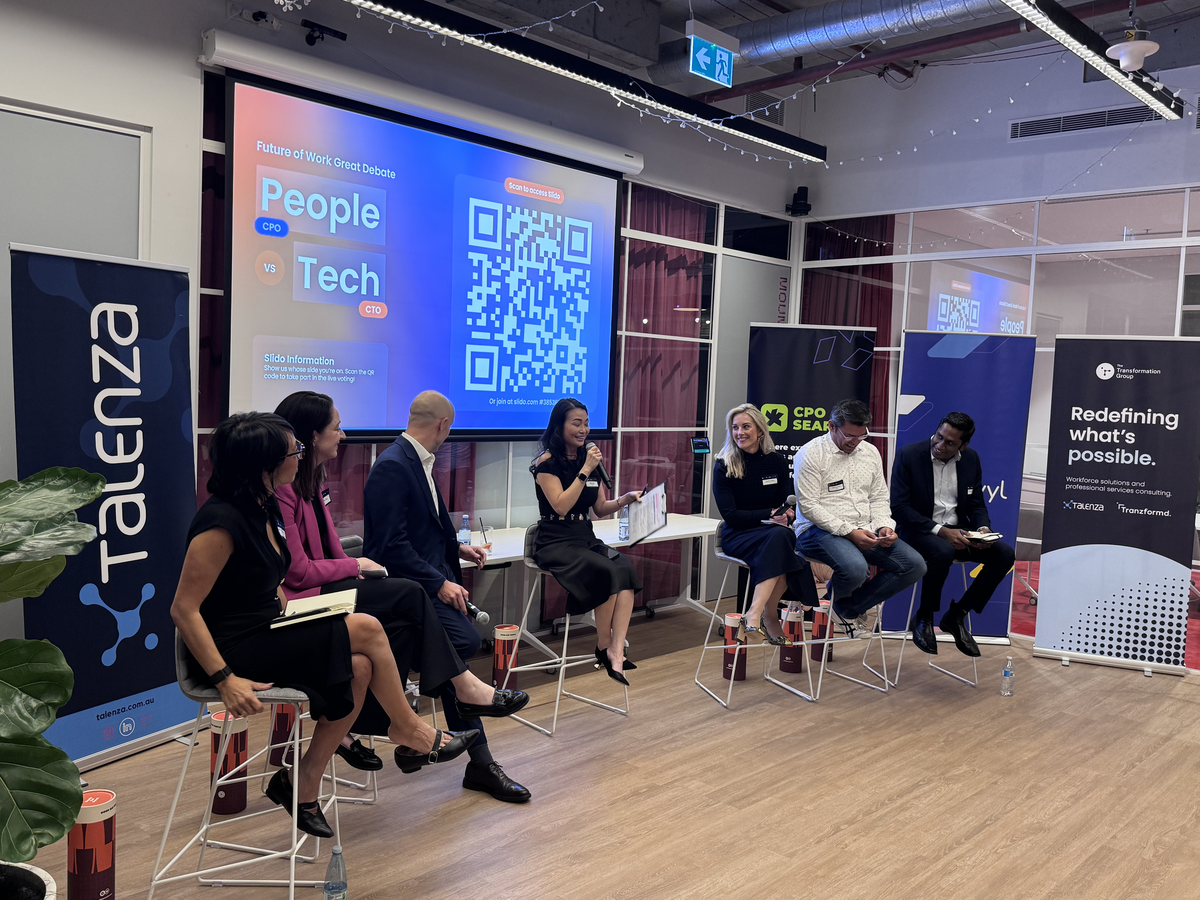
The question on the night was simple: who should lead AI transformation, the CPO or the CTO?
But as the discussion unfolded at CPO vs CTO: The Future of Work – The Great Debate, one thing became clear. The question is useful as a provocation, but it is not where the real work sits.
As one guest reflected after the event: “We keep asking who should lead enterprise AI transformation. It’s a distraction.”
The debate was not really about whether Technology or People & Culture should own AI. It was about something much bigger: AI transformation is forcing organisations to redesign work itself.
That means rethinking operating models, AI governance, decision rights, workforce capability, stakeholder alignment and how AI transformation actually gets delivered.
AI transformation is not a tool rollout
Many organisations still treat AI as a technology project. They focus on tools, platforms, pilots and productivity promises rather than a clear AI transformation strategy.
Those things matter. As Team CTO argued on the night, without ambition, architecture, data discipline, AI governance, security and execution, AI remains conversation theatre. Organisations need the technical foundations to scale enterprise AI safely and effectively.
But the room also recognised that technical foundations alone do not create transformation.
The real challenge is how AI changes the work. What gets automated? What gets augmented? Who makes decisions? What risks need to be managed? What skills need to be built? Where should accountability sit? How do people trust the outputs? How do teams work differently?
That is why AI transformation needs to be treated as AI operating model redesign, not simply technology implementation.
The operating model question is becoming unavoidable
One of the most interesting parts of the discussion was the range of views on how AI should be implemented. Guests reflected on centralised, decentralised and hybrid models, each with different implications for speed, control, AI governance and adoption.
A centralised model can create consistency, stronger governance and clearer prioritisation. But it can also slow down experimentation if it becomes too removed from where work happens.
A decentralised model can unlock speed and innovation close to the frontline. But it can also create duplication, risk and fragmented tooling.
A hybrid model may offer the most practical path for many organisations: centralised guardrails, AI governance, enablement and distributed ownership of use cases and adoption.
The right answer depends on the organisation. But the important point is that this is no longer just an IT design choice. It is an AI operating model decision.
Organisations need to define:
- Where AI accountability sits
- How AI use cases are identified and prioritised
- Who owns benefits realisation
- How AI risks are governed
- How teams are enabled to experiment safely
- What decisions remain human-led
- How work changes across functions, roles and teams
Without that clarity, AI adoption becomes scattered activity rather than aligned enterprise AI transformation.
Stakeholder alignment is the real delivery risk
One attendee asked a sharp question: are the people leading AI transformation the people closest to where work actually happens, or the people closest to the budget?
That is a useful challenge.
AI transformation will fail if it is designed too far away from the work. It will also fail if it is left entirely to local experimentation without enterprise-wide alignment. The organisations that move fastest will need both.
They will need executive alignment on ambition, investment, governance and risk. They will also need deep engagement with the teams and leaders closest to the work, because that is where the practical opportunities, blockers and adoption risks will show up first.
This is where stakeholder alignment for AI transformation becomes critical.
AI demands clear answers to questions such as:
- What problem are we solving?
- What value are we trying to create?
- Which work should change first?
- Who needs to be involved?
- What risks are we willing to accept?
- How will we measure benefits?
- What needs to be true for people to adopt the change?
- How do we avoid creating more complexity than value?
The technology may be new, but the transformation challenge is familiar. Misalignment, unclear ownership, vague benefits and poor adoption still derail progress.
AI simply makes those issues move faster.
Agility needs to become practical, not performative
Another theme from the debate was that many organisations are still working out how to measure the benefits of AI. There is enthusiasm, experimentation and visible activity, but often a gap in how value is clearly defined and tracked.
That matters because AI transformation will not be delivered through one large, fixed plan. The technology is moving too quickly, the risks are evolving, and the opportunities will continue to change.
Organisations need practical agility in their AI transformation strategy.
That does not mean endless experimentation or disconnected pilots. It means building the conditions to test, learn, scale and govern in a disciplined way.
Practical agility looks like:
- Clear prioritisation of AI use cases
- Fast but governed experimentation
- Short feedback loops with users and stakeholders
- Defined measures of value
- Visible ownership of decisions and risks
- The ability to stop, adapt or scale based on evidence
- Change activity embedded into the work, not bolted on at the end
The goal is not to “do AI”. The goal is to redesign work in ways that create measurable value, improve decision-making, reduce friction and build organisational capability.
Redesigning work means redesigning accountability
The CPO vs CTO framing created a lively debate because it exposed a bigger issue: many organisations do not yet know where accountability for AI-enabled business transformation should sit.
That is risky.
If AI sits only with Technology, it can become disconnected from people, culture and adoption.
If AI sits only with People & Culture, it can lack the technical architecture, AI governance and execution discipline required to scale.
If AI sits everywhere, it can quickly sit nowhere.
The organisations that succeed will be deliberate about accountability. They will define who owns the strategy, who governs the risk, who funds the work, who delivers the change, who measures the benefits and who is accountable for AI adoption.
They will also recognise that no single function can do this alone.
The future of work is not a technology conversation. It is not only a people conversation either. It is a work, AI operating model and transformation conversation.
Moving from debate to design
The value of the CPO vs CTO debate was not that it produced a simple answer. It was that it surfaced the tensions organisations need to resolve.
Strong technology foundations matter. So do culture, capability and trust.
Speed matters. So does governance.
Innovation matters. So does accountability.
Experimentation matters. So does benefits realisation.
The challenge for organisations now is to move from debate to AI transformation design.
That means asking:
- How does AI change the way work gets done?
- What AI operating model will help us scale safely and effectively?
- Where do we need clearer ownership and decision rights?
- How do we bring stakeholders with us early?
- What capabilities do our people need to build?
- How do we align ambition, governance, delivery and adoption?
- How do we make AI part of the way the organisation works, not a side project?
At Tranzformd, we help organisations design, align and deliver AI transformation that sticks. From AI operating model redesign and stakeholder alignment to workforce readiness and practical delivery, we work with organisations to turn ambition into execution.
AI transformation is already happening. The opportunity now is to make it intentional.